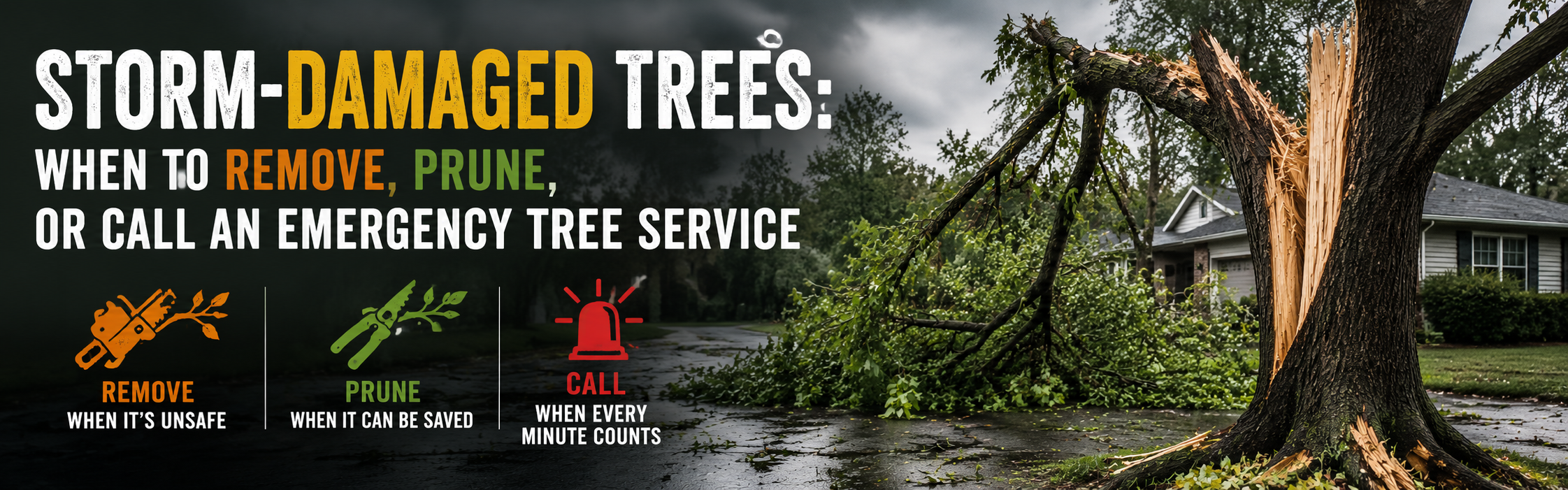
A bad storm can change your yard in a matter of minutes. One heavy branch comes down, a trunk splits, or a whole tree leans in a direction it wasn’t leaning before, and suddenly you’re standing outside wondering what to do next. In this blog, Martin’s Tree Service in Kitchener-Waterloo walks you through exactly when to call for emergency help, when pruning is the right move, and when full removal is the only safe option.
The answer depends on the type and extent of the damage. If a tree has hit your home, fallen on a car, or is resting against power lines, that’s an emergency and you need professional help right away. If the damage is limited to broken branches with the main structure still intact, professional pruning may be all that’s needed. And if more than half the canopy is gone, the main stem has snapped, or the trunk has a deep crack, removal is usually the safest path forward.
You should never try to assess or handle storm damage on your own. Damaged trees are unpredictable — a branch that looks stable can fall without warning, and a leaning tree can shift at any time. The right call is to stay clear, keep your family away from the area, and contact our team so a certified arborist can evaluate the situation safely.
What Should I Do First If a Storm Damages a Tree on My Property?
The first thing you should do is stay away from the damaged area. Don’t walk under hanging branches, get near a leaning trunk, or go anywhere close to a tree that has come down on or near power lines. Your safety comes before anything else, and storm-damaged trees are unpredictable even when they look like they’re done moving.
Once you and your family are clear of the area, call for our professional help. If there are downed power lines involved, call 911 first and then your utility provider. For all other storm damage, contact a certified arborist like our team at Martin’s Tree Service so someone with the right training and equipment can assess what’s happened and determine the safest course of action.
Don’t try to clean things up, cut branches, or move debris before our professionals has had a look. What seems like a simple cleanup can turn dangerous fast. Our team can assess the full situation, identify hidden hazards, and handle everything safely from start to finish.
When to Call an Emergency Tree Service
Some storm damage can’t wait. Certain situations are immediately dangerous and need a professional response as fast as possible. If any of the following apply to your property after a storm, call our team right away – don’t wait until morning or the next business day.
Emergency situations put people and property at serious risk. A tree resting against your house, a large branch hanging over a walkway, or a root system that has partially lifted out of the ground can all shift or fail without any warning. These are not situations to watch and wait on.
Here is when you need to call for emergency help right away:
- Structural Damage to Your Home or Property: If a tree or large branch has come down on your roof, smashed into your car, damaged a fence, or hit any structure on your property, that’s an emergency. The weight and instability of the damaged tree pose an ongoing risk until it’s professionally removed. Our team brings the equipment and expertise to extract the hazard safely and can help secure the affected area.
- Contact with Power Lines: If a fallen tree or branch is touching overhead wires, stay as far away as possible and call 911 first, then your utility provider. Never go near a tree that is in contact with power lines — the ground around it can be energized even if nothing looks visibly wrong. Our team works in coordination with utility providers to handle these situations safely.
- Sudden Leaning or Root Lift: If your tree has started leaning in a new direction after a storm, or if you can see the root ball starting to lift out of the ground, the tree is at serious risk of falling. Saturated soil after heavy rain makes root failure much more likely. This is an emergency situation that needs immediate professional attention before the tree comes down on its own.
- Large Hanging or Cracked Limbs: A heavy branch that is cracked, splintered, or hanging over your home, driveway, or walkway is a serious hazard. These are called widow-makers for a reason, they can fall without warning. Our team can safely remove hanging limbs before they cause injury or further damage to your property.
When Professional Pruning Is the Right Call
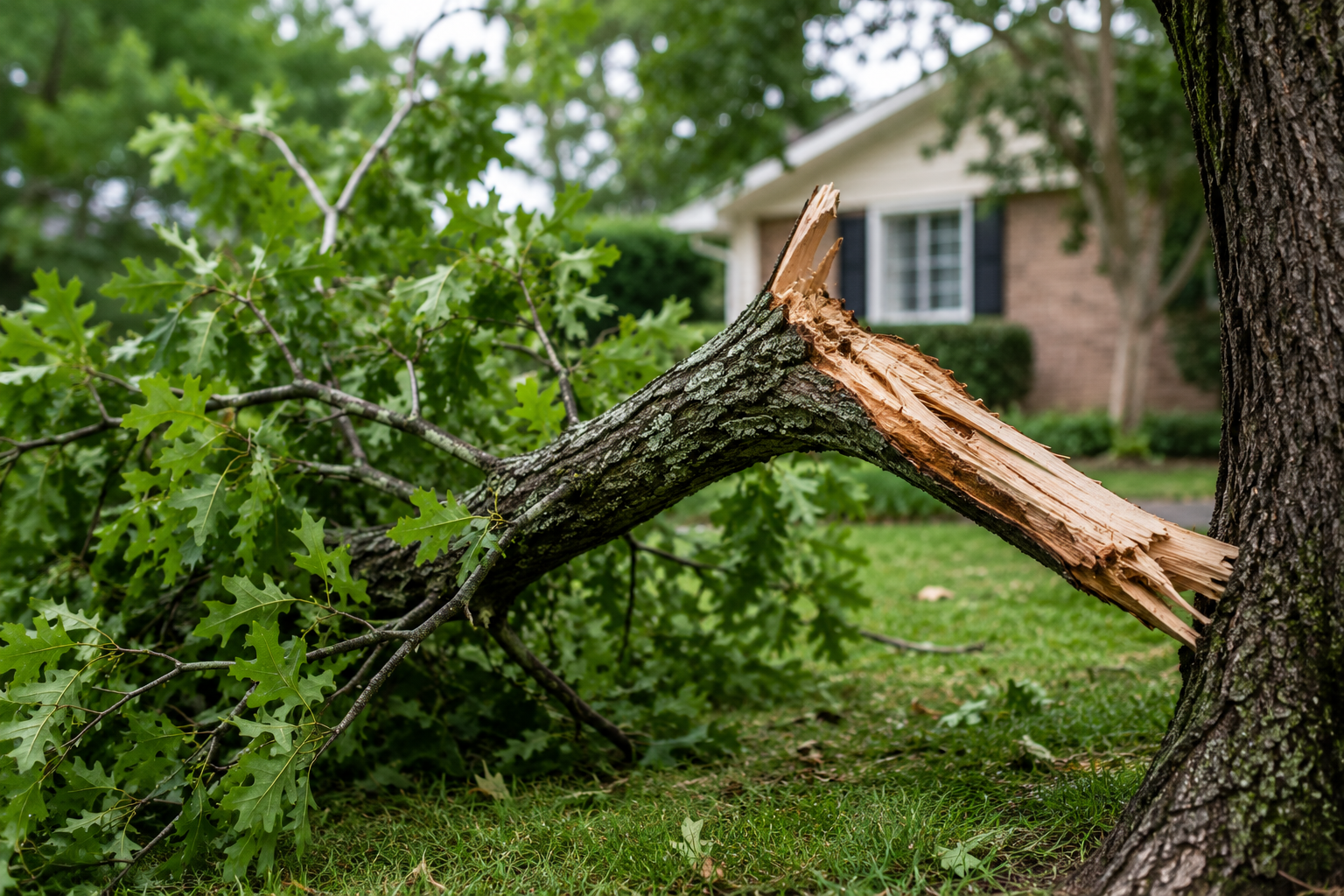
Not every storm leaves behind a crisis. Sometimes the damage is limited to broken branches, torn bark, or smaller limbs that have snapped off cleanly. In those cases, professional pruning is often all that’s needed to help the tree recover and reduce the risk of further problems down the road.
Pruning after a storm isn’t just about making things look tidy. Ragged breaks and torn bark create open wounds that invite pests and disease. A clean cut made by our professional arborists heals much better than a jagged break left on its own. That proper wound care gives the tree a better chance of recovering fully without developing secondary problems.
Here is when our professional pruning is the right approach:
- Broken Small to Mid-Sized Branches: When branches have snapped but the main trunk and major limbs are still solid, our professional pruning removes the damaged wood cleanly and helps the tree start healing. Leaving broken stubs in place creates entry points for insects and fungal disease. Our arborists make clean cuts at the right location to support healthy regrowth.
- Torn Bark on the Trunk or Main Limbs: Bark that has been stripped or torn by a falling branch needs to be cleaned up professionally to reduce the risk of rot and pest infestation. A certified arborist can assess how deep the damage goes and whether any additional treatment is needed to protect the exposed wood.
- Preventative Pruning Before Storm Season: One of the best things you can do is have your trees professionally pruned before storm season hits. Removing dead, weak, or crossing branches reduces wind resistance and lowers the chance of storm damage in the first place. Our team can assess your trees in spring or early summer and remove the wood most likely to cause problems in a storm.
When Full Removal Is the Safest Option
Sometimes a tree is too damaged to save and trying to keep it alive creates more risk than removing it. Knowing when removal is the right call is important, because a severely compromised tree doesn’t always look dangerous from the outside. Our professional assessment is the only reliable way to know for sure.
Removal is typically the right decision when the structural integrity of the tree has been broken beyond repair. That might mean the main trunk has split, the leader has snapped, or so much of the canopy is gone that the tree can’t sustain itself. In these cases, the tree is likely to decline anyway, and a slow decline means years of falling branches and ongoing hazard risk.
Here is when full removal is the safest path:
- More Than 50% of the Canopy is Gone: When a storm destroys more than half of a tree’s canopy, it struggles to produce enough energy to survive. Even if it hangs on for a season or two, it becomes more vulnerable to disease and structural failure over time. Our arborists can assess whether the remaining canopy is enough to support recovery or whether removal is the better long-term decision.
- The Main Leader or Central Stem Has Broken: The leader is the dominant upward-growing stem that gives a tree its structure and shape. When it snaps in a storm, the regrowth that follows tends to be weak and poorly attached. That new growth is more likely to fail in future storms, creating an ongoing hazard. Removal and replacement with a new planting is often the safer and smarter long-term choice.
- The Trunk Has a Deep Split or Crack: A crack that runs through the main trunk compromises the structural core of the tree. Even if both halves look stable right now, the connection between them is weakened and can fail under the weight of wind, ice, or additional growth. Our team assesses the depth and direction of splits to determine whether the tree can be safely preserved or needs to come down.
Storm-Damaged Trees in Kitchener-Waterloo
Kitchener-Waterloo sees its share of severe weather – summer thunderstorms, ice storms, and heavy wind events all cause storm damage to residential trees on a regular basis. The region’s mature tree canopy means many homes have large, established trees close to structures, which raises the stakes when a storm rolls through.
Ice storms are particularly damaging in this region. The weight of ice on branches causes limbs to snap under pressure that wind alone wouldn’t create, and the damage often happens overnight when homeowners aren’t watching. Waking up to a yard full of broken limbs and a leaning tree is something our team deals with regularly in the Kitchener-Waterloo area.
Our team at Martin’s Tree Service responds to storm damage throughout Kitchener-Waterloo and the surrounding area. We know the local tree species, the types of damage that are most common here, and the fastest and safest ways to handle emergency situations. When a storm hits your neighbourhood, you don’t have to figure out who to call, we’re here and we’re ready.
The Benefits of Martin’s Tree Service
Martin’s Tree Service has been taking care of trees in the Kitchener-Waterloo area for years, and that local experience makes a real difference when you’re dealing with storm damage. We know which species are most common in this region, which ones are most prone to storm damage, and how to assess the damage quickly and accurately. You get a team that understands your yard, not just a crew showing up with a chainsaw.
Our team includes certified arborists who assess storm damage with trained eyes before any work begins. We don’t just look at what’s visible from the ground, we evaluate the full structure of the tree, the root system, and the condition of the surrounding area to make sure nothing gets missed. That thorough approach means you get an honest, informed recommendation about what actually needs to happen.
Safety is at the centre of everything we do. Storm work is some of the most dangerous tree work there is, and our team has the training, equipment, and experience to handle it without putting your family or property at further risk. From emergency removals to post-storm pruning and cleanup, we handle the whole job so you don’t have to go near any of it.
Frequently Asked Questions
Can a storm-damaged tree be saved?
It depends on the extent of the damage. Minor branch loss and bark damage can often be managed with our professional pruning and care. But if the trunk is cracked, the main leader is broken, or more than half the canopy is gone, removal is usually the safer long-term choice. A certified arborist can assess the damage and give you an honest answer.
How quickly do I need to act after storm damage?
As quickly as possible for anything that poses an immediate hazard, hanging limbs, structural contact, or root instability all need prompt attention. For less urgent damage like broken small branches, acting within a few days is generally fine, but waiting too long allows pest and disease entry through open wounds.
Will my home insurance cover storm-damaged tree removal?
It depends on your policy and the circumstances. Many policies cover removal if the tree has damaged a structure on your property. Removal of a tree that fell in your yard without hitting anything is often not covered. Contact your insurance provider directly and ask our team to document the damage during our assessment to support your claim.
Is it safe to go into my yard after a storm?
Use caution before going outside after a storm. Check for hanging branches overhead, leaning trees, and any sign of downed power lines before walking through your yard. If anything looks unstable or if there are wires on the ground, stay inside and call for our professional help before going near the affected area.
How do I know if a tree is about to fall after a storm?
Signs that a tree may be about to fall include visible leaning that wasn’t there before, soil heaving or cracking near the base, exposed roots lifting out of the ground, large cracks in the trunk, and major hanging limbs. If you see any of these signs, stay away from the area and call our team right away.
Storm Damage Won’t Wait, Neither Should You
After a storm, the damage to your trees doesn’t stay still. Hanging limbs get heavier, cracks spread, and weakened roots shift further with every rain or wind event that follows. What looks manageable today can become a serious hazard within days if it’s left unaddressed.
You should never try to assess or handle storm-damaged trees on your own. The risks are real – falling branches, unstable trunks, and hidden structural damage can all cause serious injury without warning. The right move is to stay clear and let our trained professionals take a look.
At Martin’s Tree Service in Kitchener-Waterloo, we’re ready to respond. Our team handles emergency calls, professional pruning, and full removals with the training and equipment to do it safely and efficiently. We assess the damage, give you an honest recommendation, and take care of everything from start to finish.
Request an estimate today and let our team make your property safe again.
Steve Martin